


Cladding Curved Walls, Columns, and Arches: How to Install Tile on Complex Surfaces
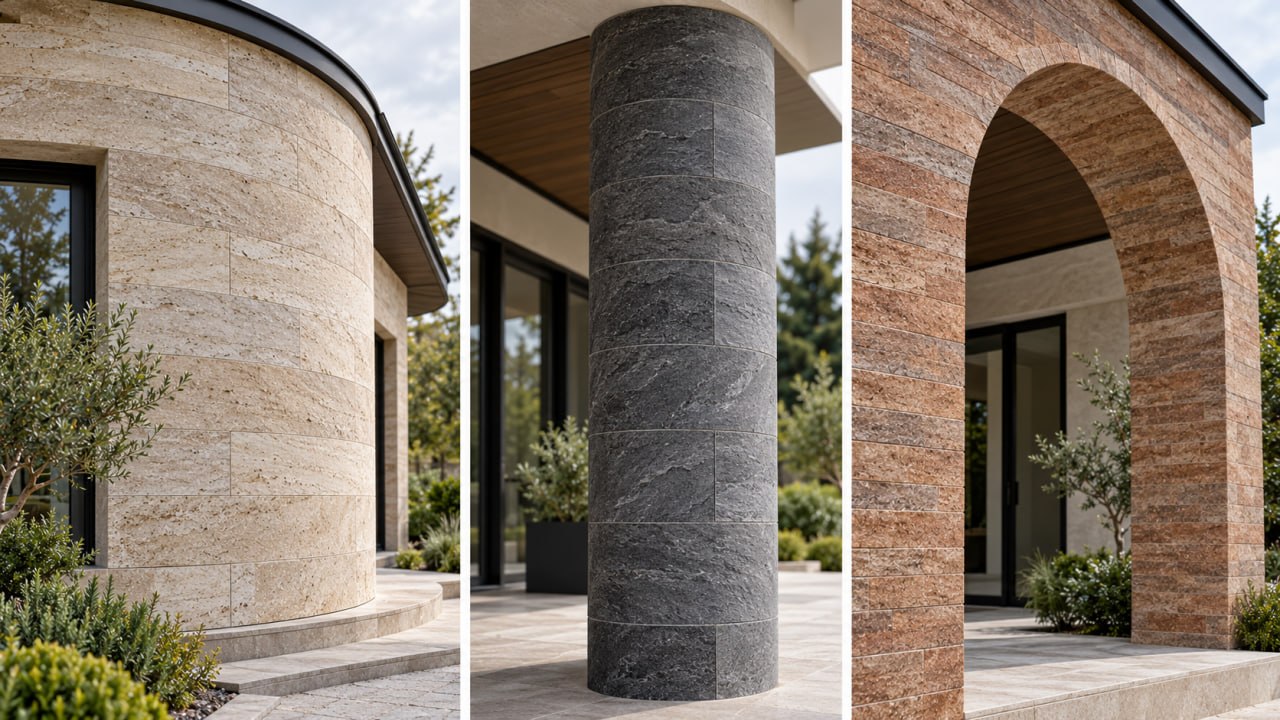
On a round column or inside an arch, rigid tile turns into dozens of cuts and extra joints. We explain how KORDEKO flexible tile follows the shape of a prepared substrate, how to clad a round column and a rounded corner, why a flat substrate matters more than the flexibility of the material, and how complex geometry affects the cost of the work.
Cladding a straight wall is relatively simple. Difficulties begin when the surface curves, such as on round columns, arched openings, rounded corners, and decorative facade elements. Standard ceramic tile or natural stone cannot follow these shapes without additional processing.
As a result, the material often has to be cut into smaller pieces, carefully fitted together, and aligned at the joints. This increases installation time and does not always produce a smooth, visually continuous surface.
However, cladding complex architectural forms does not necessarily require many separate pieces. Flexible finishing materials can follow the curves of a properly prepared substrate.
Why Is Standard Tile Difficult to Install on Curved Surfaces?
Ceramic tile, porcelain stoneware, and natural stone are rigid cladding materials. Their shape changes very little during installation.
This is not a problem on a flat wall. But when the surface becomes curved, installation becomes more complicated.
For example, if a round column needs to be clad, a standard rectangular tile cannot sit flush against the entire curved surface. Narrower elements or special installation solutions are required to create the rounded form.
Similar difficulties occur when finishing arches and rounded corners.
The main challenges include:
- Numerous cuts. The more complex the geometry, the more elements need to be adjusted.
- Additional joints. Dividing the cladding into smaller pieces changes the appearance of the surface.
- More difficult alignment. Even small deviations become noticeable on smooth curves.
- Longer installation time. Preparing and fitting each element requires additional work.
This does not mean rigid cladding cannot be used on columns or arches. Such solutions are possible, but they require a suitable format and more careful preparation.
Flexible Tile as an Alternative to Rigid Cladding
For surfaces with complex geometry, mineral-polymer tile that can bend without breaking can be used.
KORDEKO Flexible Tile (PletaFlex) consists of a decorative mineral layer and a reinforcing non-woven membrane. Its composition includes mineral components and an acrylic binder that provides the required flexibility.
Unlike conventional ceramic tile, flexible tile can follow the shape of a properly prepared substrate. This makes it suitable not only for straight walls, but also for columns, arches, rounded corners, and other architectural elements.
At the same time, the surface can retain the appearance of natural stone, slate, or brick.
Flexibility is particularly useful when the goal is to avoid a large number of small pieces and preserve the continuity of the decorative pattern.
However, the material is not intended to correct geometric defects in the substrate. If the wall has bumps, depressions, or weak areas, these must be repaired before installation.
How to Clad a Round Column
Columns are one of the clearest examples of where flexible tile can be useful.
When rigid materials are used, a round surface has to be divided into separate sections. The smaller the column radius and the larger the tile, the more difficult it is to achieve a neat fit.
Flexible cladding allows the installation to be approached differently.
The material is placed onto the prepared surface and gradually pressed into position so that it follows the curve. Thanks to the tile’s flexibility, it may be possible to create a continuous decorative area without cutting the material into many narrow strips.
Several points should be considered during installation.
First, the substrate should be even around the full circumference of the column. Irregularities can prevent the material from making uniform contact with the surface.
Second, the adhesive should be distributed evenly. After installation, the tile should be pressed firmly with a flat float to remove trapped air.
Third, the layout should be planned in advance so that joints between elements do not disrupt the overall pattern.
The permissible bending of a specific tile depends on its format, thickness, and texture. For columns with a small radius, the suitability of the selected material should therefore be checked before installation.
Cladding Arches and Rounded Corners
Arched openings are often among the most difficult areas in facade and interior finishing.
The inner curved surface of an arch is particularly challenging because the material must maintain even contact throughout the curve.
Flexible tile simplifies this task because it can follow the surface without requiring numerous cuts.
A similar principle applies to rounded building corners.
Instead of creating the transition from multiple narrow pieces, a flexible element can wrap around the prepared corner.
This helps preserve the visual continuity of the stone texture.
However, the tile should not be forced into an excessively sharp bend. If the substrate geometry requires too tight a curve, a different tile format or layout should be selected.
Why Is Substrate Preparation Especially Important on Complex Shapes?
The flexibility of the material simplifies installation, but it does not replace proper surface preparation.
Before cladding, dust, dirt, loose coatings, and unstable areas should be removed, and the substrate should be checked for cracks and voids.
Where necessary, the surface should be leveled and treated with a suitable primer.
KORDEKO installation requires an adhesive selected according to the substrate type and operating conditions. A frost-resistant adhesive is used for exterior applications.
According to the manufacturer’s instructions, a 4 mm notched trowel is used for smooth tiles and a 6 mm notched trowel for textured tiles.
After installation, the material should be pressed carefully to ensure even contact with the surface.
Particular attention should be paid to transitions between flat and curved areas. Voids should be avoided and adjacent elements should be properly joined.
If the decorative cladding is installed over insulation, Facade Insulation should include a continuous reinforcement layer and proper preparation of all architectural elements.
The general requirements for external thermal insulation composite systems (ETICS) are set out in the European assessment documents published by EOTA.
Can Flexible Tile Be Installed on an Uneven Wall Without Leveling?
It is important to distinguish between a curved surface and an uneven substrate.
A rounded wall or column can have correct geometry. In this case, the flexibility of the tile allows it to follow the intended curve.
But if the surface has random irregularities, cracks, projections, or areas of peeling plaster, the cladding will not correct those defects.
Because the material is thin, it follows the shape of the substrate, which means pronounced defects may remain visible after installation.
For this reason, the surface must be strong and sufficiently even before the tile is installed.
Flexible tile is intended for cladding complex shapes, not for replacing leveling or repair layers.
How Does Complex Geometry Affect Installation Cost?
When calculating facade cladding, it is important to consider not only the total wall area but also the number of architectural details.
Columns, arches, niches, bay windows, and rounded corners increase labor requirements, especially when rigid materials are used.
Numerous cuts require extra time and can increase material waste.
Flexible tile can reduce the number of these operations. The material can be cut with a utility knife or scissors, and its ability to bend makes non-standard surfaces easier to finish.
However, the actual savings depend on the specific project. Complex geometry still requires accurate marking, substrate preparation, and careful installation.
For this reason, different cladding options should be compared according to the complexity of the architectural elements, not only by the material price per square meter.
See also: a 4 mm or 6 mm adhesive layer under flexible tile; large or small tile format for a facade; cornices without cracks at the joints.
Conclusion
Round columns, arches, and curved walls do not necessarily have to be clad with numerous small pieces. When the goal is to maintain the appearance of natural stone while following a complex surface shape, flexible tile can be a practical alternative to rigid materials.
Thanks to its mineral-polymer construction, KORDEKO can bend and adapt to properly prepared curved substrates. This simplifies the finishing of architectural elements and can reduce the amount of cutting required.
However, the final quality still depends on the geometry of the substrate, correct tile format, suitable adhesive, and proper installation.
The main advantage of flexible cladding on complex surfaces is not that it can hide construction defects, but that it can accurately follow a shape that conventional rigid tile cannot accommodate without additional processing.
Frequently asked questions
Can a round column be clad with flexible tile?
Does flexible tile hide an uneven wall?
Which trowel is used for flexible tile?
Need advice on your facade?
- Get a free consultation for your project
- Find out which material suits your facade
- We'll answer all your questions and help you choose