


Fast Facade Installation Without Complex Equipment: How KORDEKO Flexible Tile Simplifies Finishing Work
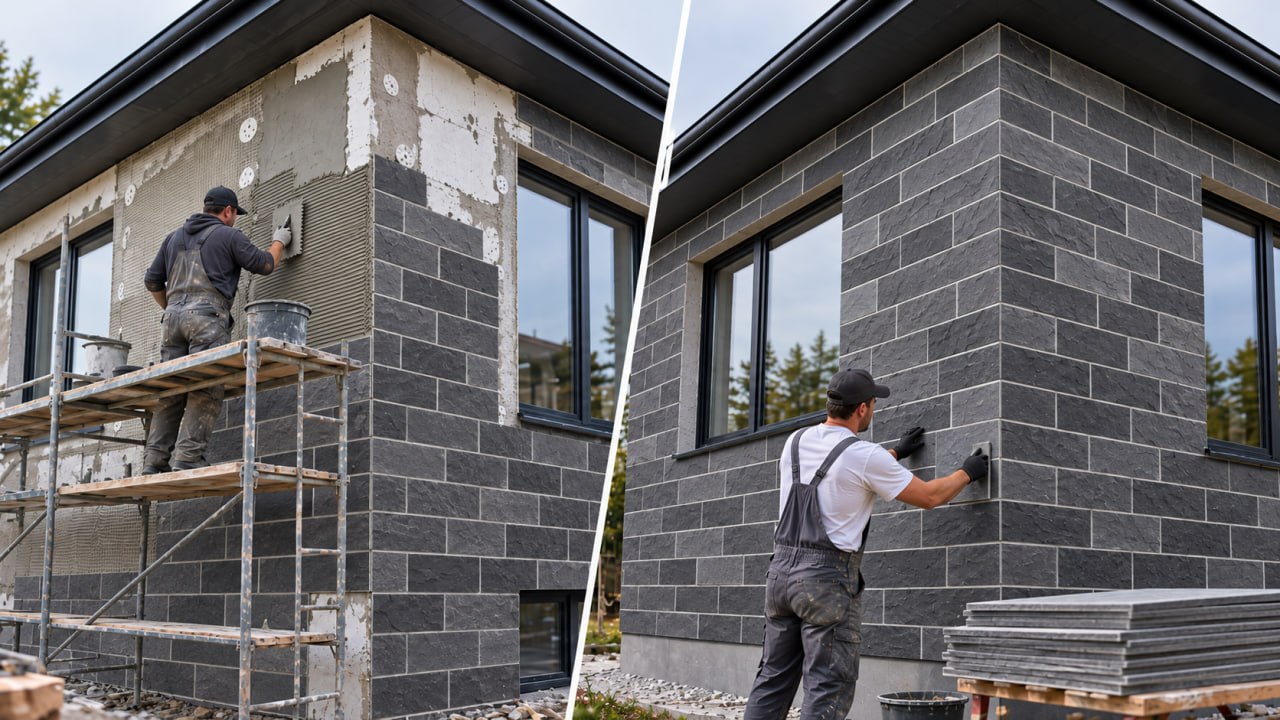
Facade cladding can take several weeks or even months. The duration of the work depends on the selected material, the condition of the walls, the complexity of the architecture, and the number of installers.
Heavy natural stone requires additional attention to fixing and processing. However, there are cladding materials that can simplify installation. One of them is flexible tile, which can be installed using standard construction tools.
Why Traditional Cladding Takes More Time
When working with heavy facade materials, installers face several challenges: transportation, lifting slabs, cutting, and the need for reliable fixing.
Finishing columns, arches, and rounded corners can be especially difficult. Rigid materials must be carefully adapted to the geometry of the surface, which increases labor time.
In addition, the high weight of the cladding may place additional requirements on the substrate and fixing system.
That is why, when choosing a facade finish, it is important to consider not only the price of the material, but also the cost and complexity of installation.
How Quickly Can KORDEKO Flexible Tile Be Installed?
KORDEKO Flexible Tile (PletaFlex) is produced on a mineral-polymer base and has a relatively low weight of approximately 4 kg/m².
The material can be easily cut with a utility knife or scissors. Thanks to its flexibility, the tile can be installed on curved surfaces without complex processing.
According to the KORDEKO technical description, one installer can lay up to 25 m² of tile per day. For a facade area of 250 m², the manufacturer gives an estimated cladding time of 1–2 weeks.
However, these figures should not be considered guaranteed. Actual installation speed depends on substrate preparation, the number of windows and corners, tile format, and layout complexity.
If the walls require leveling or additional reinforcement, the total renovation time will increase.
What Tools Are Needed for Installation?
One of the advantages of flexible stone is that no complex cutting or processing equipment is required.
The main tools include:
- a roller for applying primer;
- a trowel and notched trowel;
- a flat float for pressing the tile;
- tape measure, ruler, and pencil;
- utility knife;
- sponge for removing excess adhesive.
For smooth tiles, KORDEKO installation instructions specify a 4 mm notched trowel, while textured tiles require a 6 mm notched trowel.
After the adhesive is applied, the tile is placed onto the surface and pressed firmly to remove trapped air from beneath the cladding.
However, the absence of specialized equipment does not mean that installation can be carried out without proper skills. Installation quality directly affects the durability of the cladding.
Why Substrate Preparation Matters More Than Speed
The most common mistake in fast facade renovation is trying to save time on preparation.
Before installation, the walls must be checked for strength, weak areas must be repaired, the surface must be cleaned, and a suitable primer must be applied.
OSB and sandwich-panel substrates require special preparation. According to the installation method, they should be treated with concrete-contact primer, leveled where necessary, and reinforced with fiberglass mesh.
When carrying out Facade Insulation, cladding should only begin after the thermal insulation and reinforcement layers have been installed correctly.
The general requirements for external thermal insulation composite systems (ETICS) are set out in the European assessment documents published by EOTA.
Work should never be accelerated by ignoring drying times or the adhesive manufacturer’s recommendations.
See also: a 4 mm or 6 mm adhesive layer under flexible tile; can flexible tile be installed in a heatwave; cladding an old facade without demolition.
Conclusion
Fast facade installation without complex equipment is possible when the right cladding material is selected and the substrate is properly prepared in advance.
KORDEKO Flexible Tile simplifies installation thanks to its low weight, flexibility, and easy cutting. This is particularly useful for facades with complex geometry.
However, speed should not become the main priority. A reliable result depends on following the installation technology, preparing the substrate correctly, and selecting suitable adhesive materials.
Frequently asked questions
How much flexible tile can be laid in a day?
Which tools are needed to install flexible tile?
Can time be saved on substrate preparation?
Need advice on your facade?
- Get a free consultation for your project
- Find out which material suits your facade
- We'll answer all your questions and help you choose