


Low-Maintenance Facade: How Often Cladding Needs Cleaning, Repairs, and Maintenance
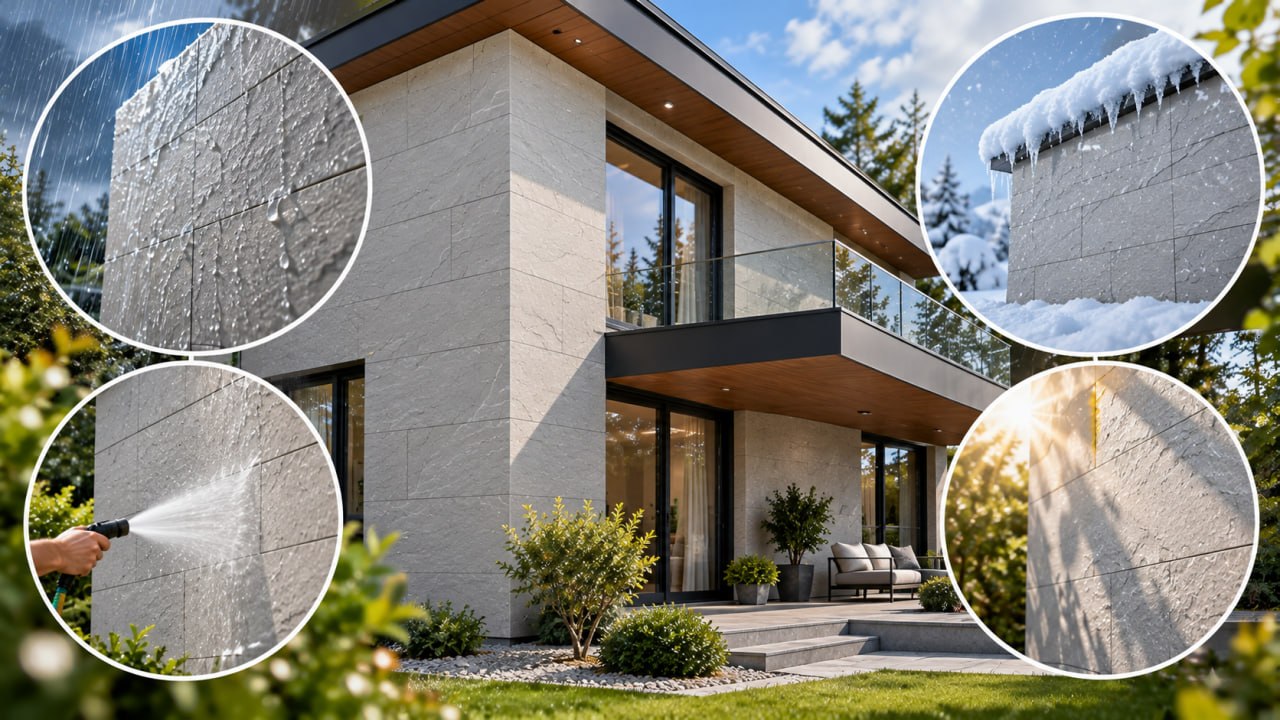
There is no universal washing schedule for a facade: it depends on where the house stands and what it is clad with. We compare render, stone, ceramic and KORDEKO flexible tile for upkeep, explain how to clean flexible stone with water and a sponge, when repairs are due and why single elements can be replaced without stripping the facade.
A facade is exposed every day to dust, rain, temperature fluctuations, and sunlight. Even high-quality cladding becomes dirty over time, and some areas may eventually require repair.
However, not all facade materials need the same level of maintenance. Some finishes require periodic repainting and restoration, while others mainly need cleaning and inspection. That is why, when choosing a facade finish, it is important to consider not only the initial cost, but also future maintenance expenses.
How Often Should a House Facade Be Cleaned?
There is no single cleaning schedule that applies to every facade. Maintenance frequency depends on the location of the building, the type of finish, and surrounding conditions.
For example, walls near busy roads become dirty faster than facades located away from heavy traffic. Areas beneath windows, near downpipes, and along the lower part of the building also require more attention.
When maintaining a facade, it is recommended to:
- inspect the surface periodically for dirt and deposits;
- remove contamination before it becomes difficult to clean;
- check the condition of gutters and window sills;
- use cleaning methods suitable for the specific cladding material.
At the same time, overly aggressive cleaning can damage certain decorative finishes.
Which Facade Materials Require Less Maintenance?
Different cladding materials have different maintenance requirements.
Decorative render may require periodic repainting, especially if the surface loses color or develops cracks. In KORDEKO comparison documentation, some rendered finishes are indicated as requiring repainting approximately every 3–5 years.
Natural stone is durable, but some types may require special protective treatments. Ceramic tile does not require regular repainting, although joints and fixing systems still need to be monitored.
KORDEKO Flexible Tile (PletaFlex), according to the manufacturer’s technical description, does not require periodic repainting or the regular application of protective treatments.
Its decorative layer contains UV-resistant oxide pigments, while the mineral-polymer base is moisture-resistant and designed to withstand atmospheric exposure.
How to Clean KORDEKO Flexible Stone Correctly
To maintain the appearance of flexible tile, accumulated dirt should simply be removed when necessary.
According to the manufacturer’s recommendations, the surface can be cleaned with water using a soft sponge or brush. The technical description also allows the use of pressure washing, although specific safe pressure settings are not provided.
For this reason, the cleaning method should always take into account the condition of the cladding, and excessive pressure that could damage joints or adhesive bonds should be avoided.
One of the advantages of KORDEKO is that the material does not require regular renewal of its decorative color. This reduces the number of routine maintenance tasks required over the life of the facade.
When Does a Facade Need Repair?
Even when durable cladding is used, the entire facade system should still be inspected periodically.
Particular attention should be paid to areas around windows, roofs, balconies, and the plinth. Damaged junctions can allow moisture to penetrate behind the decorative finish.
If Facade Insulation has been installed, the condition of the reinforcement layer and exterior finish should also be monitored. Cracks or delamination may indicate problems within the thermal insulation system.
The general requirements for external thermal insulation composite systems (ETICS) are set out in the European assessment documents published by EOTA.
If KORDEKO Flexible Tile is locally damaged, the technical documentation allows individual elements to be replaced without removing the entire cladding system.
However, before carrying out repairs, the cause of the damage should be identified, especially if the problem is related to the substrate or moisture penetration.
See also: rain streaks on a facade; the lotus effect on a facade: why water runs off the cladding; how long a house facade lasts and what decides it.
Conclusion
A low-maintenance facade is not a surface that never needs attention. It is a facade system that requires minimal regular renewal.
KORDEKO Flexible Tile does not require periodic repainting or special protective treatments. To maintain a neat appearance, it is generally enough to clean the surface when necessary and monitor the condition of the facade system.
Timely repair of minor damage, properly functioning drainage, and correct maintenance can help prevent more expensive repairs in the future.
Frequently asked questions
How often should a house facade be cleaned?
What do you clean KORDEKO flexible tile with?
Can a damaged area be replaced without stripping the facade?
Need advice on your facade?
- Get a free consultation for your project
- Find out which material suits your facade
- We'll answer all your questions and help you choose